
Author:
archblog_admin
Published on
November 26, 2025
Categories:
Dummy category | Second category


A tenacious woman ahead of her time — and the first modernist architect from Sri Lanka, Minnette de Silva was once one of the world’s most famous woman architects. But alas, despite surviving and fighting for her spot at the big table in such a male-dominated field, her name is now all but forgotten. It is a shame that the traces of her legacy- the buildings that she had designed- are mostly abandoned and others have been destroyed entirely, wiped from the earth to make room for luxury lots and soulless skyscrapers. Why is it that, a project such as Falling Water, designed by Frank Lloyd Wright- is treasured so deeply and treated as a historical landmark visited by millions? Still, the decorated works of de Silva are destroyed and replaced by ‘modern architecture’. The replaced projects display no sensitivity to the history, culture, or geography destroying the former context- and it is certain she would have been highly disappointed. She had been acquaintances with the likes of Henri Cartier-Bresson, Picasso, and Laurence Olivier and was deemed as a ‘close friend’ of Le Corbusier- however, the details of their relationship were never confirmed but remain a witty mystery for many. Whether their relationship was romantic has remained the subject of speculation, the possible affair depressingly defining much of the narrative around De Silva’s life and work since. In a letter dated June 1949, de Silva writes: ‘Corbu. So, so long a time without a letter. Have you forgotten altogether the little bird of the Islands … Paris seems so far away and I am very nostalgic for it all’. ‘Oiseau de l’Ile,’ writes Le Corbusier in 1952 from Chandigarh. ‘I am a crow, and crows look at flowers … with passion, but the flowers ignore them … I kiss you, Minnette, to the very tips of your fingers.’ Think what you may from this information…
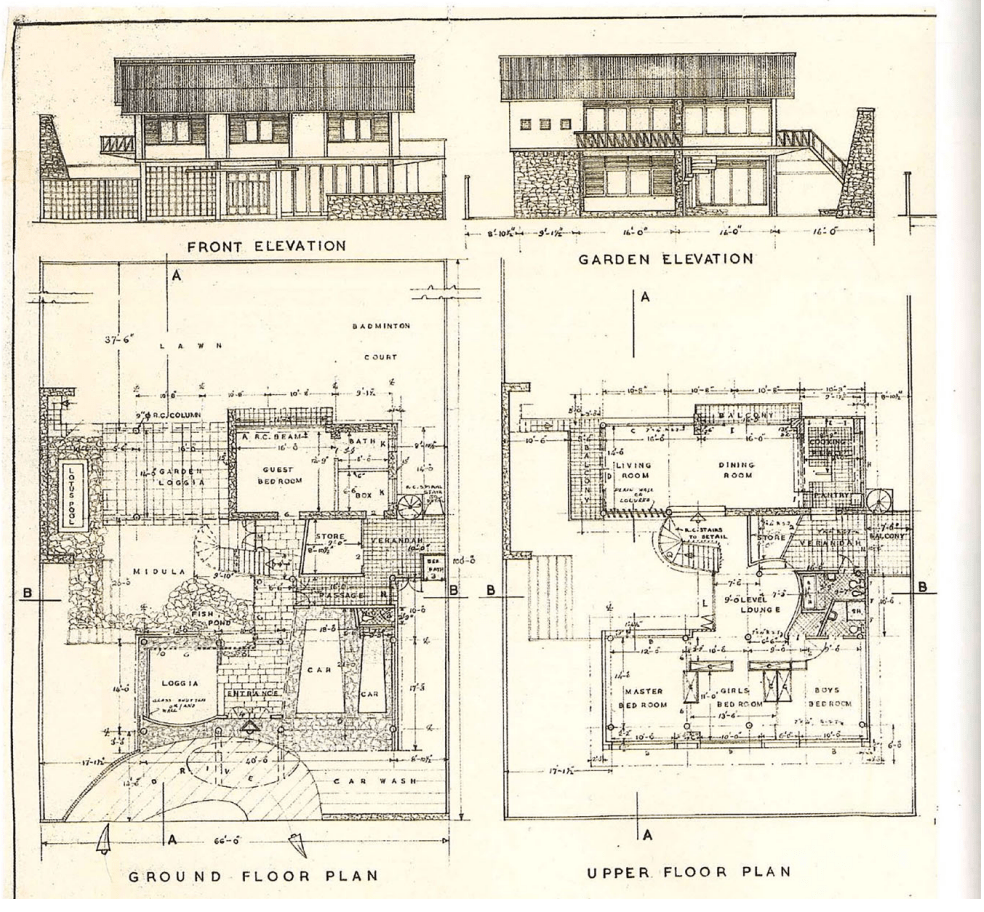
Still, the decorated works of de Silva are destroyed and replaced by ‘modern architecture’.
Her first design coming back was the Karunaratne House in Kandy. Designed for friends of her parents, she wanted to synthesize the traditions of a modern religious family in this house. She designed this house based on understanding the contoured site and how climate-responsive her architecture could be. She designed the south elevation to be solid, whereas the north elevation consisted of shaded balconies and various fenestrations. She also understood that the Karunaratnes were conservative people, which is why her vertical zoning is quite evident in the section of the house, with the public areas at the top, a mezzanine, and then the private rooms at the bottom, towards the back.
Bawa’s work is largely inspired by Minnette’s but without acknowledgment. His designs include pilots for efficient utilization of space and efficient natural ventilation and courtyards to enhance that, around which he based his designs. He too worked with a mixture of traditional, on-site materials, and modern materials. This broke Minnette’s heart, and she started experimenting with different materials like concrete, for curved cast concrete roofs, she strayed from her style looking for acceptance and recognition. This did not prove to be a successful attempt as seen in the Nadesan House of 1961 in Kandy.
In 1965, she designed the last house that was truly reflective of her style, the Chandra Amarasinghe House. This was a perfect amalgamation of all her beamless ceilings, pilotis, open plans, spiral staircases, and split levels. It was almost like she herself bade her designs farewell, with a massive impact.

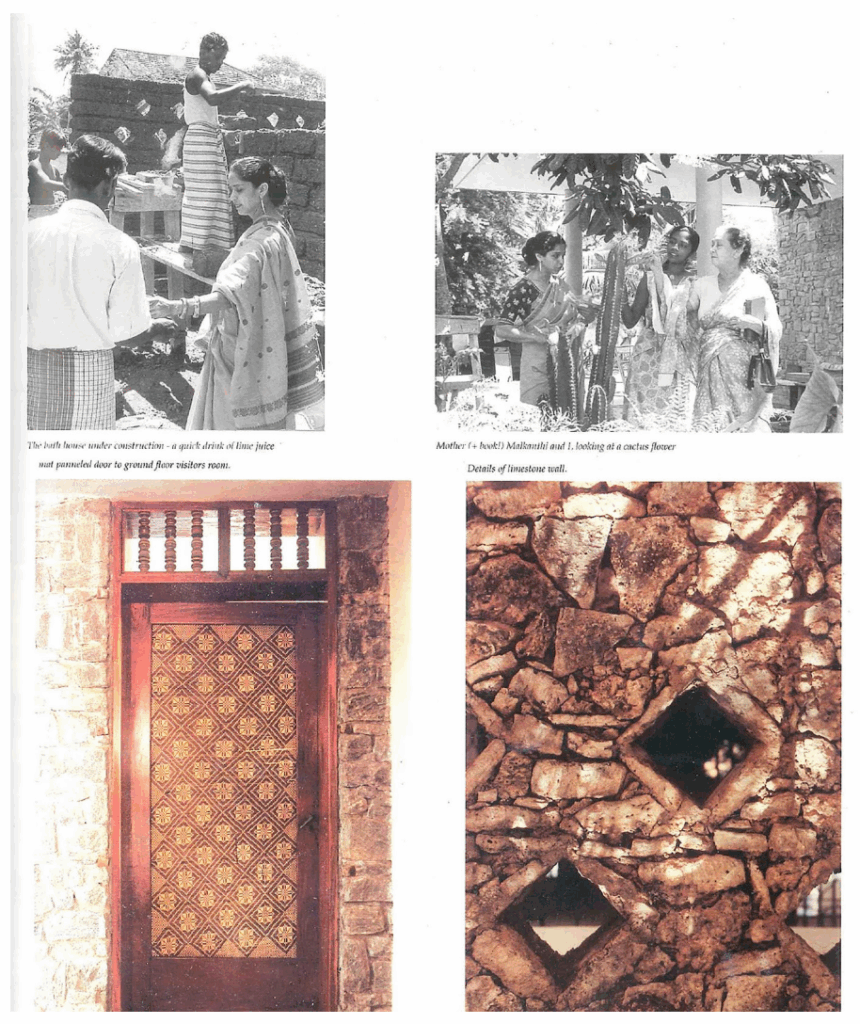
The 1960s was a very difficult period for Minnette. She found herself questioning her own abilities, and with completely shattered confidence, she designed her last project in 1982. The Kandy Arts Association of 1982, was Minnette’s last work that she designed and took part in the construction of. It was heavy steel construction, which collapsed and was rebuilt. It was chaotic in its material choice, which wasn’t cohesive. It was chaotic in its design, with nothing that would identify as Minnette de Silva’s work. It was an arts center for local craftspeople to express their creativity, she provided them with a space that was designed for them. She in turn provided the local craftspeople with a place where they were wholeheartedly accepted, unlike she had been her whole life. Minnette de Silva’s life was one of rebellious women, born in the wrong century.
Her design philosophies and contributions towards mud and earth techniques were decades ahead of their time. Being a woman in the industry was tough and she was often questioned about her every move- however, she was always assertive and would not stand for any discrimination The harsh reality that still stands is that after her death her enduring legacy is mostly gone or lying in ruins. Nobody cared enough to honor which is a shame as we can often see traces and elements of her legacy in the architecture that is so widely loved today. She may be gone, with nobody to remember her- however her influence in Colombo’s modern architecture- from the expansive Kandyan-styled roofs of Sri Lanka, to handwoven textiles, lacquerware, and brasswork seen in boutiques and hotels will forever remain.

Hi! Im an architect and my interests lies mainly in graphic design and illustrations. I dream of working in branding as well as using my architectural roots for a career in interior design. Representing emotions and feelings through art is a powerful thing and I hope one day people feel happiness and comfort through what I create.